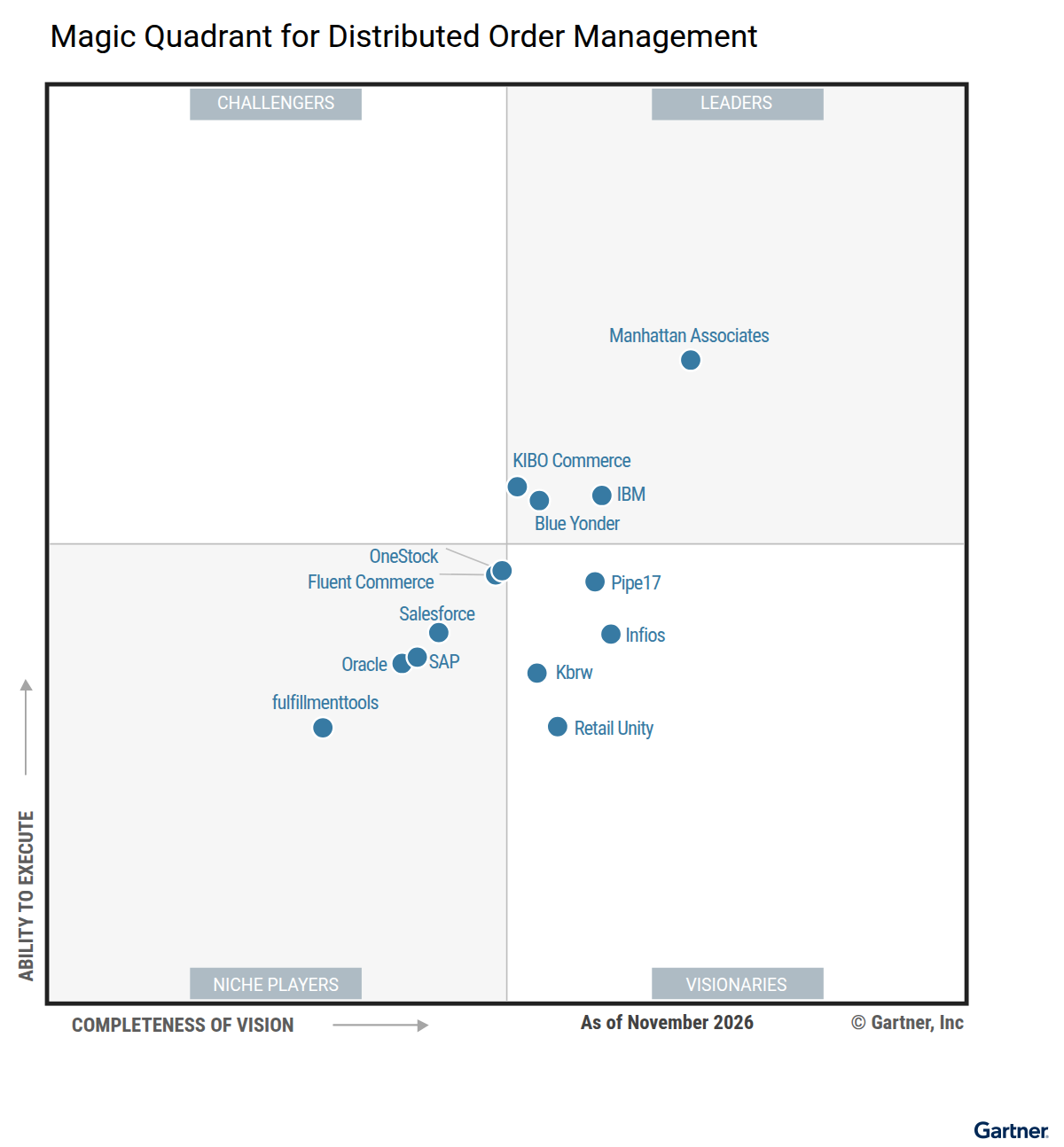
Gartner just published its first-ever Magic Quadrant for Distributed Order Management. If you work in order management, you've probably already seen the announcement. If you're deciding whether to care about the report, here is what I think matters most, and it isn't the ranking itself.
The finding that deserves more attention than it's getting is buried in the market overview section, stated plainly enough that it's easy to skip over: "The macro trend is a convergence between B2B and B2C order management."
That single sentence explains more about why this category needed its own ranked evaluation than any argument about market maturity. It also explains why choosing a DOM vendor has gotten harder, not easier, in the last two years.
Why convergence is the story, not the quadrant
For most of the last decade, enterprise commerce technology organized itself around a clean separation. B2C companies built for speed and consumer experience. B2B companies built for contract complexity and account hierarchy. The systems reflected that division: you bought a retail-focused OMS or you built on your ERP. The two categories barely overlapped in vendor evaluations, and they barely overlapped in buyer profiles.
That separation is breaking down. Online-only brands are adding wholesale channels. Manufacturers and distributors are standing up direct-to-consumer storefronts alongside their traditional dealer and distributor networks. Industrial and CPG companies are running B2B portals and consumer websites against the same SKUs and the same inventory pool.
When that happens, the clean architecture collapses. Two separate systems, one optimized for B2B, one for B2C, can't share inventory state in real time. Promises made in one channel become inaccurate by the time the other channel needs the same stock. Customer commitments break. The manual workarounds, such as planners deciding by hand, nightly sync jobs, and ring-fenced inventory that gets out of date, pile up. It's not a process problem. It's an architecture problem, and it only surfaces once the two channels are genuinely competing for the same inventory.
Gartner's market overview is direct about this: "For many clients, running two sets of applications for these channels is no longer feasible because inventory can become siloed and order promises can be inaccurate."
That's the actual market condition driving DOM adoption right now. Not a sudden discovery that order management is important. A structural breakdown in the two-system model that most companies assumed would hold indefinitely.
What the report's methodology is actually measuring
One of the most useful things about this evaluation, and something the quadrant graphic alone doesn't communicate, is the way it's structured across distinct use cases.
The companion Critical Capabilities report evaluates 14 vendors against five use cases: B2B (Other), B2B Wholesale/Distribution/CPG, B2B+B2C, E-Commerce, and Unified Commerce. Each use case applies a different weighting to the same 12 underlying capabilities. B2B Features, for example, carry 30% of the total score in the B2B (Other) use case and zero percent in the E-Commerce use case. The same vendor, evaluated against the same underlying capability scores, can land in very different positions depending on which use case you apply.
This matters for anyone using this report to inform a purchasing decision. A vendor's quadrant position is a composite view across its entire business: vision, go-to-market, global presence, customer base, revenue. The Critical Capabilities scores are weighted specifically to your operating model. The two reports can and do tell different stories about the same vendor.
Gartner's recommendation in the report itself: don't use the quadrant without the Critical Capabilities alongside it. That guidance is worth taking literally. The B2B+B2C use case, in particular, is where the convergence story shows up in the actual scoring, and it's the use case that most closely represents where the market is heading, not just where it's been.
What "B2B features" actually means in this context
It's worth unpacking what the report means when it lists "B2B Features" as a scored critical capability, because the term can read as a catch-all.
Gartner defines this capability narrowly: the specialized functionality needed to support B2B order flows, things like contract pricing, approval workflows, order validation, and requirements that vary customer by customer.
In practice, across the vendors profiled, actual B2B requirements covered include: blanket order management, customer-specific inventory entitlement, minimum-fill and ship-complete rules, primary distribution center enforcement, pre-allocation and priority sourcing by customer tier, contract-specific substitution logic, scheduled demand with future supply pegging, and account-level rules that persist across individual order transactions.
None of that is an edge case in a wholesale or manufacturing environment. It's the baseline operating model. The reason most ERP-based workarounds eventually break down is precisely this list: each of these requirements involves a live decision against dynamic inventory, not a rules lookup against a table of static contract terms. An ERP is built to store those contract terms accurately. It's not built to execute fulfillment decisions against them in real time, across multiple channels, while simultaneously allocating the same inventory to a D2C transaction on a website.
The DOM market's B2B investment push is a response to exactly that gap. Gartner notes that DOM vendors have made "strong investments in B2B-specific features such as inventory allocation and contract management", driven by growing interest from distribution, wholesale, and manufacturing buyers who are running into the ERP ceiling at exactly the moment they're also adding consumer-facing channels.
Three things worth knowing before you use this report
-
This is a first edition, and that changes what you can read into it. Every mature Magic Quadrant lets you see direction: which vendors moved, which stalled, where the market is trending based on year-over-year shifts. This one is a single data point. Since this is the first report, some evaluation criteria may still be developing, presumably because there's no longitudinal track record yet to score against. Use it as a current-state snapshot, not as a trend line. Also consider looking at other analyst evaluation reports such as IDC and Forrester to get a thorough understanding of how vendors compare across the full market landscape.
-
The inclusion criteria set a floor, not a ceiling. To qualify, vendors needed at least five customers over $1 billion in revenue. That's a reasonable filter for a report aimed at enterprise buyers. It also excludes strong vendors focused on the midmarket and high-growth brands that may never reach that qualification bar. If your own company doesn't look like the enterprise profile the eligibility criteria describe, this report covers the top of the market, not necessarily your end of it.
-
The quadrant measures the vendor. The Critical Capabilities measures the fit. A Leader can score behind Visionaries on a specific use case. A Niche Player can be the strongest option for a buyer whose requirements align closely with that vendor's specialty. What you're buying is a system that serves your operating model. The quadrant tells you which vendors have built strong businesses. The use-case scores tell you which ones built the right product for your situation.
Who actually needs to pay attention right now
If you've already shortlisted DOM vendors, you've moved past the question this section is for. So let me be direct about who isn't past that question yet.
- You're running multiple business models against one inventory pool. A D2C website and a wholesale portal, a retail store network and a B2B distributor channel, anything where B2C demand and B2B demand are pulling from the same supply. This is the convergence Gartner describes as the defining trend in the category. If you're managing that with two systems, the inventory synchronization problem is already there; it may just not have surfaced as a named issue yet.
- You're in distribution, wholesale, manufacturing, or CPG, and you've started getting questions about consumer-grade buying experiences. The "B2C-like experience for B2B customers" pressure is showing up in RFPs and renewal conversations across these verticals. It's not abstract: customers who buy from Amazon on a Sunday expect the same delivery-promise accuracy from their industrial supplier on a Tuesday. That expectation is driving B2B DOM adoption faster than any internal systems audit.
- You're planning an ERP cloud migration. The report specifically identifies this as a trigger for DOM evaluation. Once you're already replatforming one system, the question of what your ERP was doing for order management, and whether it was actually doing it well, or whether custom logic was doing it badly, becomes unavoidable. It's the natural moment to separate the system-of-record job from the real-time fulfillment execution job.
- You're making 2027 omnichannel fulfillment investment decisions. Gartner's 2025 Future of Supply Chain survey found that 57% of retail respondents named omnichannel fulfillment their top investment area. That usually shows up in planning documents as a strategy goal. This report is what delivers on it in practice.
A note on AI in this evaluation
It's worth acknowledging the timing. This category gets its first ranked evaluation at exactly the moment AI is becoming a real differentiator in DOM, not a roadmap footnote.
Gartner's data from its 2026 User Wants and Needs Survey: 24% of retailers reported positive ROI from traditional AI in DOM applications, among the highest levels across all supply chain applications. AI adoption in customer fulfillment optimization had the highest deployment rates of any supply chain function.
The practical AI applications in leading DOM systems right now: ML models for order routing that factor in cost, margin, markdown risk, capacity, and service levels simultaneously. Predictive delivery promising that improves accuracy over static rules. Agentic AI assistants that help business users configure routing logic without technical support and that surface fulfillment exceptions before they become customer-facing problems.
The honest caveat from the same research: only 18% of retailers are ready for agents to operate independently, without human oversight, by 2028. The buyers who will get real value from AI in DOM in the near term are the ones who start with use cases where AI-generated recommendations are reviewed and acted on by humans: routing decisions with explainability, safety stock recommendations with manual configuration, exception flagging that surfaces to a planner rather than resolving automatically. That's not a limitation on ambition. It's the actual adoption curve.
Where KIBO fits
KIBO was evaluated in this first ranked cycle and placed as a Leader. What I'd point to beyond the quadrant position is the alignment between KIBO's customer base and the convergence thesis running through the report.
KIBO's OMS customers span retail, CPG, manufacturing, distribution, and wholesale, the precise mix of business models Gartner identifies as converging into one category instead of staying separated by vendor. KIBO's highest-scoring use case in the Critical Capabilities report is B2B (Other), based on what Gartner describes as "a strong set of B2B capabilities combined with highly capable order orchestration and extensibility features", including deterministic order orchestration, end-to-end workflow management, embedded AI, and no-code rule configuration across unified B2B and B2C channels, none of which requires custom development.
Gartner also highlights specific roadmap investments underway: advanced inventory segmentation, B2B returns processing, demand forecasting, stock-out prediction, and AI agents for order routing optimization and demand insights, all of which point in exactly the direction the convergence thesis requires from a platform.
The quadrant is one reference point. If you want the full picture, download the Gartner Magic Quadrant for Distributed Order Management and read it alongside the Critical Capabilities, specifically the B2B+B2C use case scores.