Your inventory lives in a dozen places. Every order has to pick one.
That choice, made thousands of times a day, shapes your margin, your delivery promise and whether the customer comes back. Distributed order management (DOM) is the layer that makes it, sending each order line to the best place to ship from. Get it wrong and you pay in split shipments, stockouts and broken promises.
In this blog, I’ll cover what enterprise DOM has to do and where the market is heading. I’ll also cover what sets KIBO apart. In short, KIBO fits your existing tech stack with commerce, is easy to configure and extend, is purpose-built for B2B, and uses AI to drive adaptation and antifragility.
OMS of Old wasn’t built for Distributed Order Management
Traditional order management handled one channel, one order and one shipment. That worked until commerce and orders stopped fitting the mold. Retail, wholesale, dropship, marketplaces and 3PL now run side by side, often on separate systems with separate inventory counts.
Your ERP is not the answer either. It is built as the financial system of record: ledgers, master data, purchasing. That is what it does best. It is not built to take high-volume digital orders, promise a delivery date in real time or pick the best location to ship each one from, which is why order management systems (OMS) exist and why running distributed order management takes more than an ERP.
Spend is following the pain. Forrester projects the core OMS software market growing from $1.0 billion in 2021 to $1.9 billion by 2026, a 12.3% CAGR.
The category that has emerged is Distributed Order Management (DOM): one orchestration layer between where orders come from and where they ship. Your ERP keeps the books. Your WMS runs the four walls of a warehouse. Neither can decide, in real time, which location in your network should fill an order. That is the DOM’s job.
The Modern Jobs-to-be-Done of an Enterprise DOM
- One inventory truth. A real-time view across distribution centers, stores, 3PLs, dropship vendors and inbound purchase orders. Inventory is split into logical segments (on-hand, safety stock, channel allocations, in-transit) so a consumer promotion cannot drain stock committed to a wholesale account.
- Smarter routing. Choose the best location for each order line by cost, speed and capacity, not by a static list of rules.
- Promise dates you can trust. Available-to-promise logic checks what is on hand and what is inbound. Operational forecasting ensures you have the right inventory at the right place so inventory never hits zero.
- Event-driven orchestration. Every change, whether it's a store sale, a warehouse receipt or a supplier update, publishes an event. Availability updates across channels in milliseconds instead of waiting for a nightly batch.
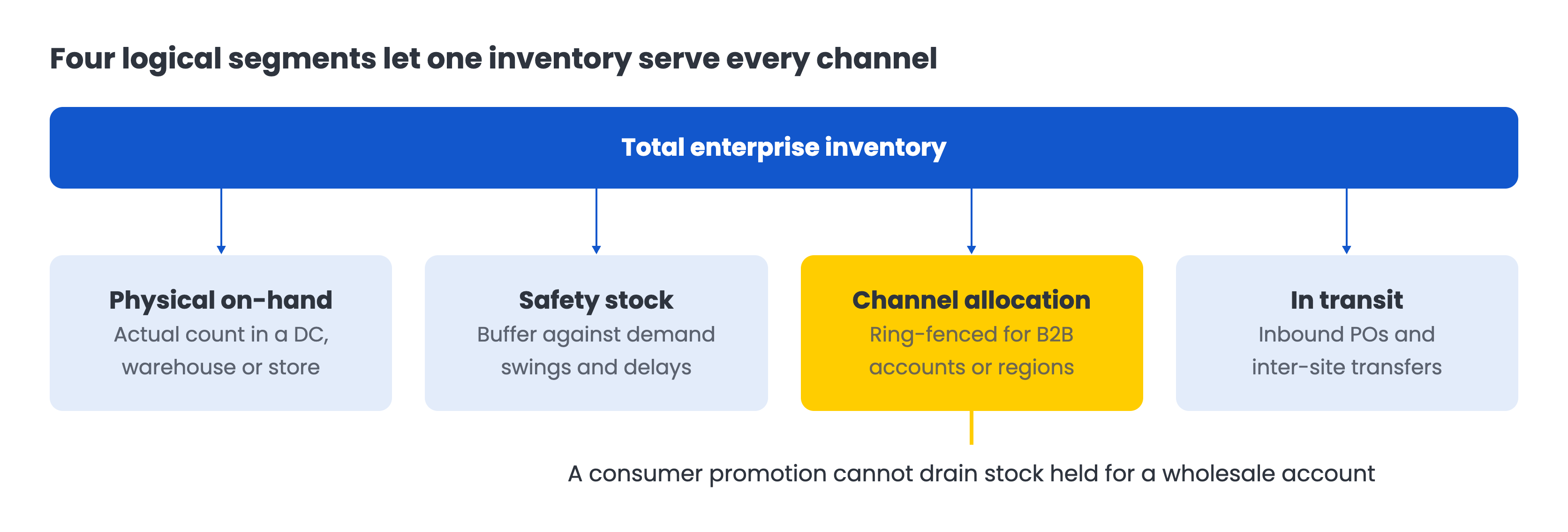
Logical segments sit on top of physical stock, so one count serves every channel.
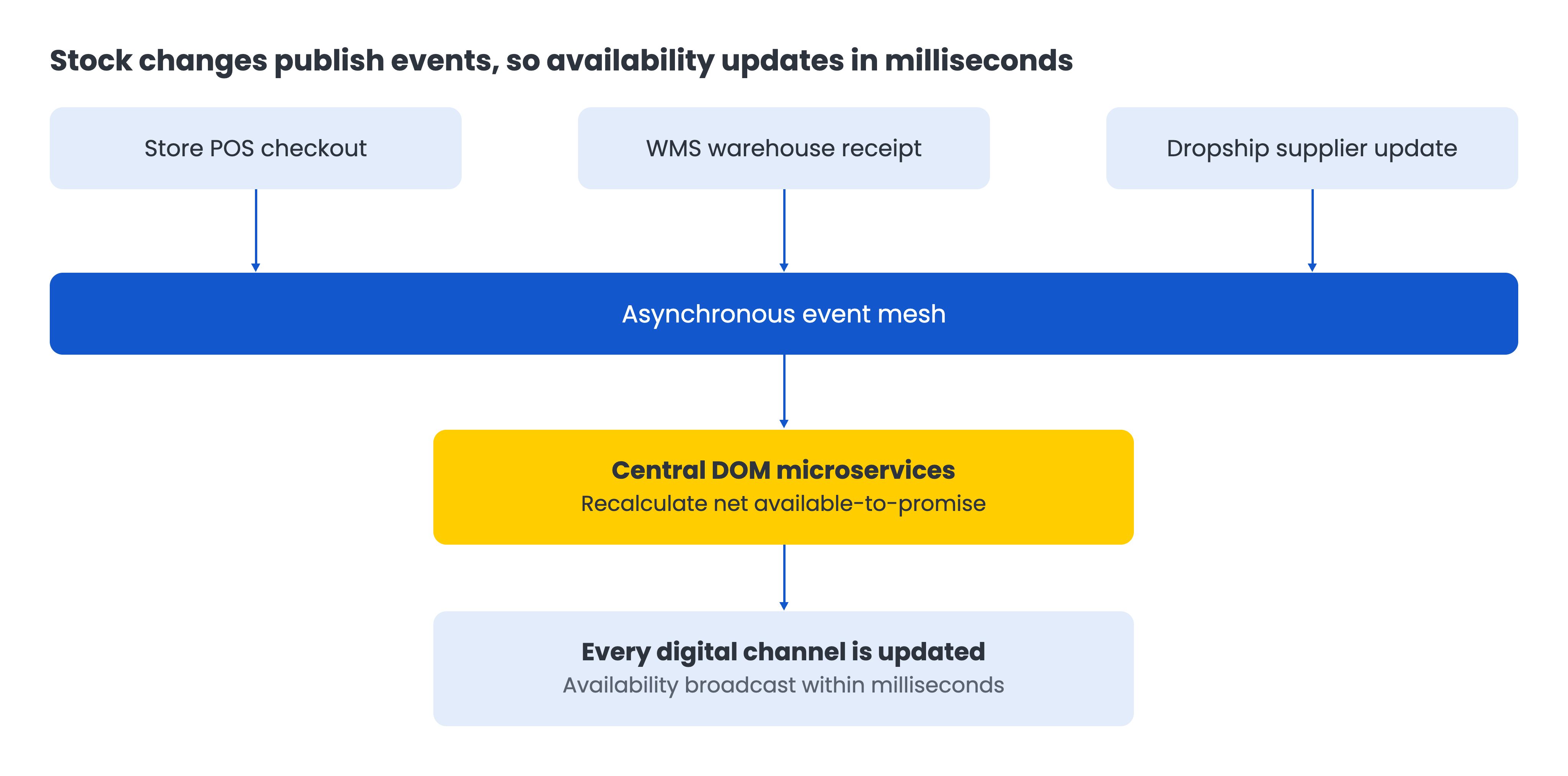
Events replace nightly batch syncs, so a change anywhere shows up everywhere almost instantly.
Get these four right and overselling, split shipments and broken promises fade away. Get them wrong and teams hold extra inventory, locking up working capital and bloating the balance sheet purely out of fear.
What makes KIBO’s Distributed Order Management different
Distributed order management looks different in every industry, and KIBO is built around that.
KIBO fits your existing tech stack: Some of the best-known DOM vendors sell order management as part of a larger warehouse and supply chain suite, and it works best next to their own WMS. KIBO’s order routing is WMS-agnostic, and KIBO works with multiple ERPs. We orchestrate across whatever warehouse, ERP and execution systems you run, plus 3PLs, stores and dropship vendors, so you can add a warehouse, change a WMS, run more than one ERP or absorb an acquisition without re-platforming.
Commerce plus supply chain: KIBO is both an OMS and a commerce platform where supply meets demand in real time, all built on one data model. The storefront, the B2B portal and the DOM share the same inventory, catalog and orders, so the delivery date a buyer sees at checkout is the date the DOM is working to keep. There is no second vendor to integrate and no gap between what the front end promises and what the back end can do.
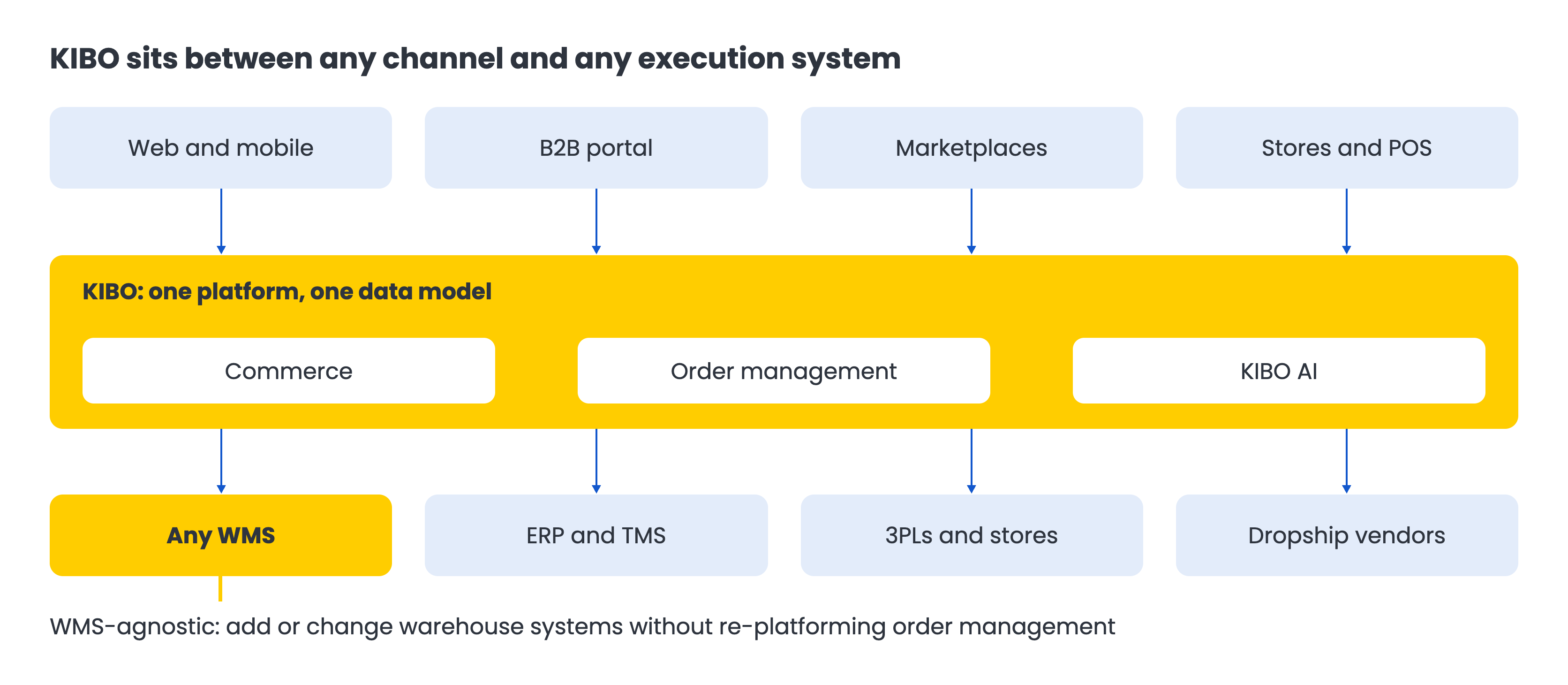
Channels on top, execution systems below, and one platform in between.
We handle every way an order gets delivered: Ship from a DC, ship from a store, pick up in store, dropship from a supplier, or fulfill through a 3PL. Everything that has to do with getting an order to the customer runs on the same platform, with the same inventory and the same promise dates.
Quick to start, simple to use, and easy to extend: KIBO is built from composable services that are API-first, cloud-native, and headless (MACH), allowing you to start with the pieces you need and add modules, from dropship to B2B to subscriptions without a rebuild. Business operators can set routing and release rules through an intuitive, no-code admin interface, giving planners, service reps, and fulfillment teams clear visibility to adapt as conditions change. Meanwhile, extensible APIs empower developers to build custom capabilities when unique needs arise, enabling fast implementations and effortless long-term growth.
Customer and industry first: Different industries need different things from a DOM, and KIBO listens. A large share of our R&D goes into what customers ask for, and those needs are gathered into one product across industries, so customers benefit from the collective. That is how KIBO keeps extending order management as the DOM market keeps growing.
B2B is the hardest test of any DOM
The gap is easy to see. A consumer shops: add to cart, pay, one parcel. A wholesale buyer commits.
A seasonal agreement is a promise to deliver in full over months, with different quantities, dates and destinations each time, at tiered prices, sometimes to hundreds of sites. IDC describes B2B orders as operating on “an entirely different scale of complexity and potential cost.”
A system built around one order and one shipment cannot hold that promise. Teams end up tracking commitments in spreadsheets and chasing exceptions by hand. Meanwhile, manufacturers who start selling direct need to keep consumer orders from eating the stock promised to wholesale accounts. The old model has no answer for either.
B2B also starts before the order. A distributed B2B buyer asks for a quote, negotiates terms and only then commits. A DOM for B2B has to manage the quote and the order it converts into on the same data, so what was negotiated is what gets reserved and shipped.
What KIBO accelerates from Commitment through Fulfillment
KIBO built its B2B OMS and Commerce around the commitment. It starts at the quote, manages the quote and the order it converts into on one data model, then follows the signed agreement through every drawdown, reservation and release, on the same platform that runs every other KIBO order.
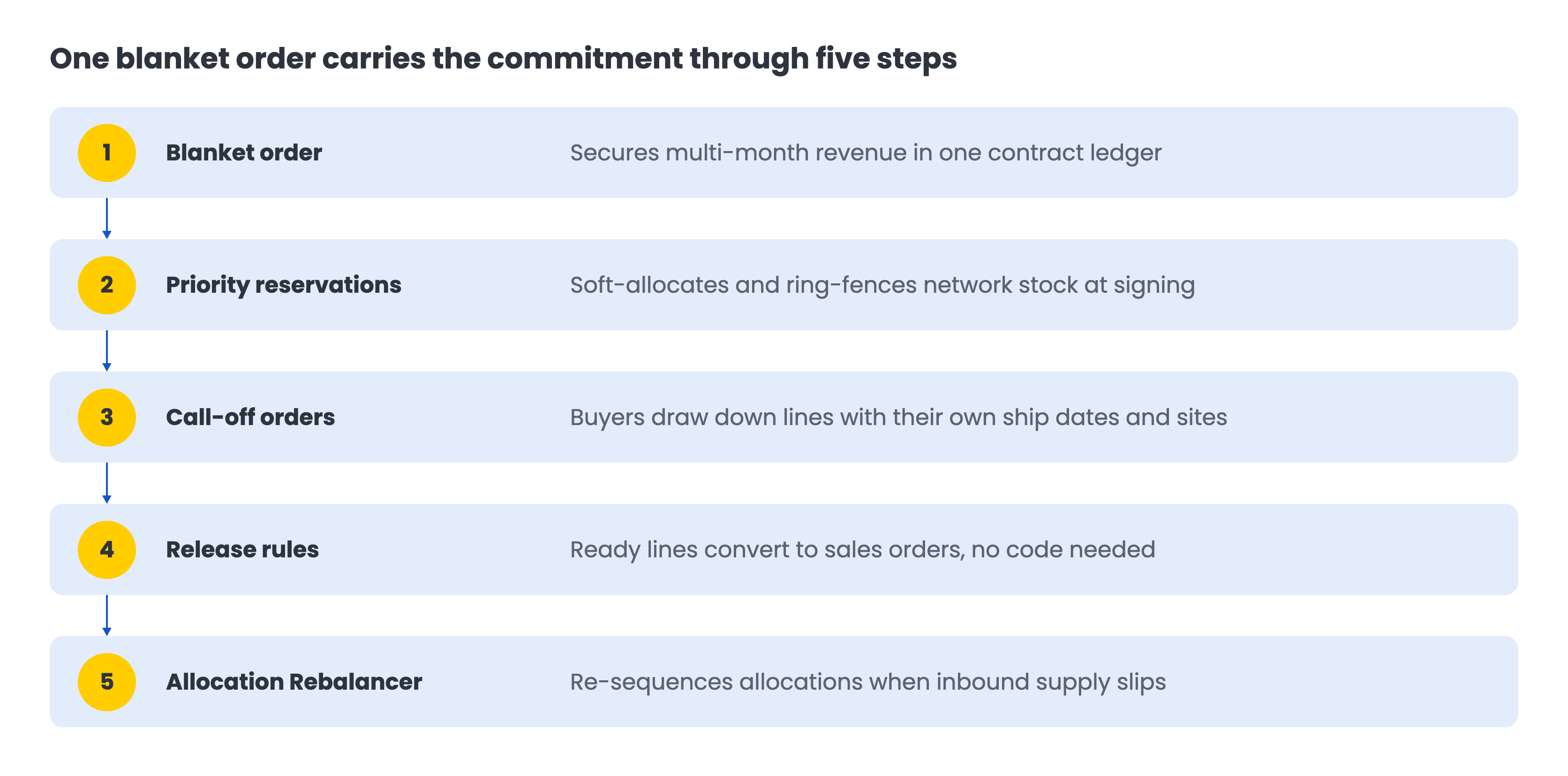
Each step hands off to the next on the same contract, so nothing has to live in a spreadsheet.
The commitment stays whole. A blanket order holds the entire seasonal agreement in one place, and call-off orders let buyers draw it down on their own dates and to their own sites. Inventory is reserved the moment the agreement is signed, so the quantity you promised in March is still there in August.
Your warehouse only sees work that is ready. Release rules turn lines into sales orders when fill rates and ship dates line up, and your team sets those rules in the admin without writing code. The spreadsheet that used to track commitments goes away.
You decide who gets served first when supply slips. Priority-based reservations protect strategic accounts. When an inbound shipment runs late, the Allocation Rebalancer re-sequences open contracts in the order you define, and backorders ship by account, product or shipment priority instead of first in, first out.
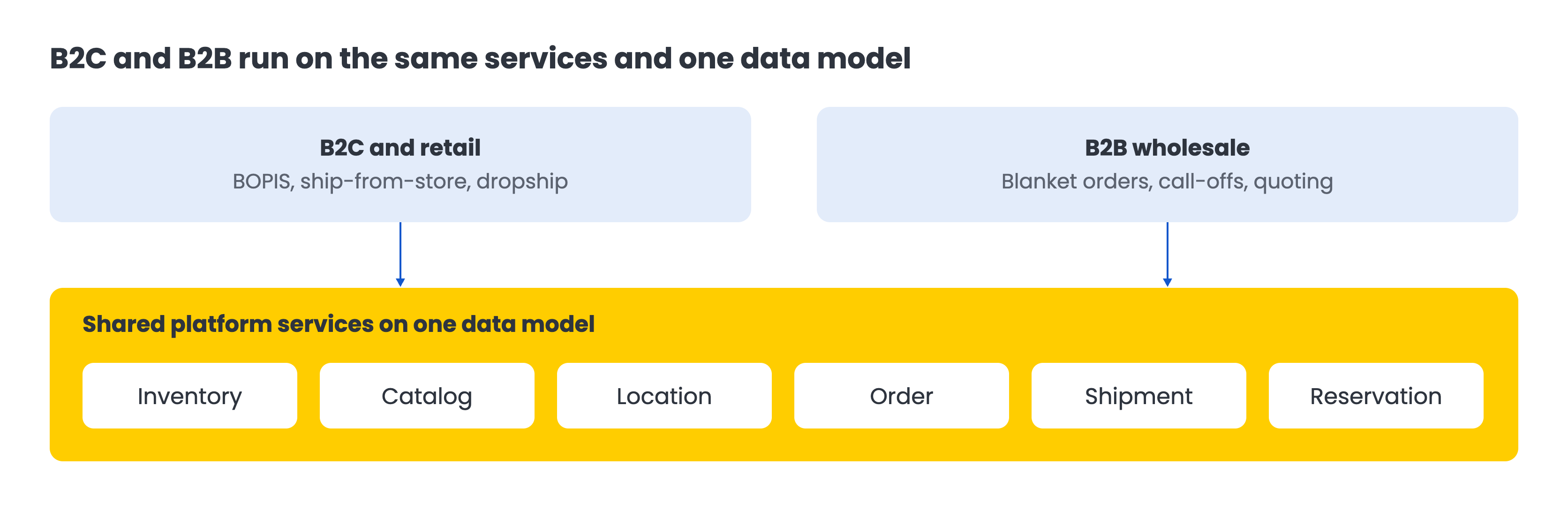
All of it sits on one platform. B2C, B2B, hybrid and dropship share one data model and the same core services: inventory, catalog, location, order, shipment, reservation, and more. Add a business model, brand, channel or location without adding additional systems or re-platforming. New customers get B2B wholesale order capabilities from day one, and existing customers can add them as they need.
Adaptive AI, built for Distributed Order Management
AI in distributed order management has a specific job: help the people who run a network of locations, carriers and contracts make better decisions, faster, on live data. KIBO AI is built for that; it is one agentic layer inside the platform, running on the same data model that spans commerce and order management, so every answer and every action rests on what is actually happening in your orders, inventory and fulfillment. It sits on top of a platform that is already no-code to configure and simple to read, so AI makes a clear system faster instead of papering over an out-of-date and confusing one.
Engage answers the question every buyer and service rep asks: where is my order, and when will it arrive? It handles order status and returns in conversation using live order and shipment data.
Configure turns a plain-language request into a change to your DOM setup, such as routing weekend orders to stores. It prepares the change, and you review and save it in Admin.
Explain tells you why. Why did this order ship from a store instead of the nearest DC? Why did a promise date move? Again, answers come in plain language from live data.
Analyze surfaces trends and anomalies across the full order and inventory data model.
KIBO MCP Server opens the platform to the AI tools your teams and partners already use. It exposes KIBO operations as standard tools that any MCP-compatible AI agent can call, so agents can act on live order, inventory and routing data, not just talk about it.
Optimize is where this is heading. In DOM, the variables that matter most, such as inventory allocation and fulfillment service levels, move every day as supply, demand and capacity change. Optimize watches them and tunes them toward goals you set, so the network adjusts before a stockout instead of after. It is a first look at what optimization means for distributed order management.
That is what adaptive means for DOM. Supply slips, a location hits capacity, a promotion spikes demand. A rule set written last quarter cannot keep up, and an adaptive layer can: it explains, recommends and, within the guardrails you set, acts. Every action runs under your own permissions, and every run is on record.
KIBO AI is also model-agnostic. Bring OpenAI, Anthropic, Google Gemini or an open-weight model, and switch whenever you choose. The aim is antifragility, so the DOM gets stronger every time conditions change.
Converging Analysis
KIBO is positioned as a Leader in Gartner’s Magic Quadrant for Distributed Order Management. In Gartner’s Critical Capabilities research, B2B is KIBO’s highest-scoring use case. Gartner points to a strong set of B2B capabilities combined with capable order orchestration and extensibility.
The orchestration engine runs allocation, reservation and rebalancing in a predictable, non-overlapping priority order, and business users set the rules with no code across B2B and B2C channels.
IDC reached the same conclusion from the B2B side. It named KIBO a Leader in the 2026 IDC MarketScape for AI-Enabled Order Orchestration and Fulfillment Applications for B2B and Manufacturing, noting that KIBO Order Management runs on the same platform and shared data model as KIBO Commerce and KIBO Subscriptions. KIBO is also the only vendor named a Leader in both The Forrester Wave™: Commerce Solutions, Q3 2026 and The Forrester Wave™: Order Management Systems, Q1 2025.
What could this be worth to you? Run your own numbers in the B2B OMS Benefits Calculator.
Where to start
Replacing an order management platform should never be a big-bang cutover. A phased path keeps risk low:
- Draw the boundaries. Decide what your ERP, WMS, POS and OMS each own, and standardize master data for products, locations and carriers.
- Audit real scenarios. Map the standard paths (DC ship, BOPIS, ship-from-store, dropship) and the messy ones (splits, cancellations, backorders, returns). Test any platform against them.
- Choose composable, event-driven integration. API-first services and an event mesh keep availability current.
- Roll out in phases. Pilot one region, brand or workflow. Measure pick-to-ship time, split rates, promise accuracy and cost-to-serve against your baseline.
- Add AI once routing is stable. Then let explainable agents handle exceptions and tune safety stock.
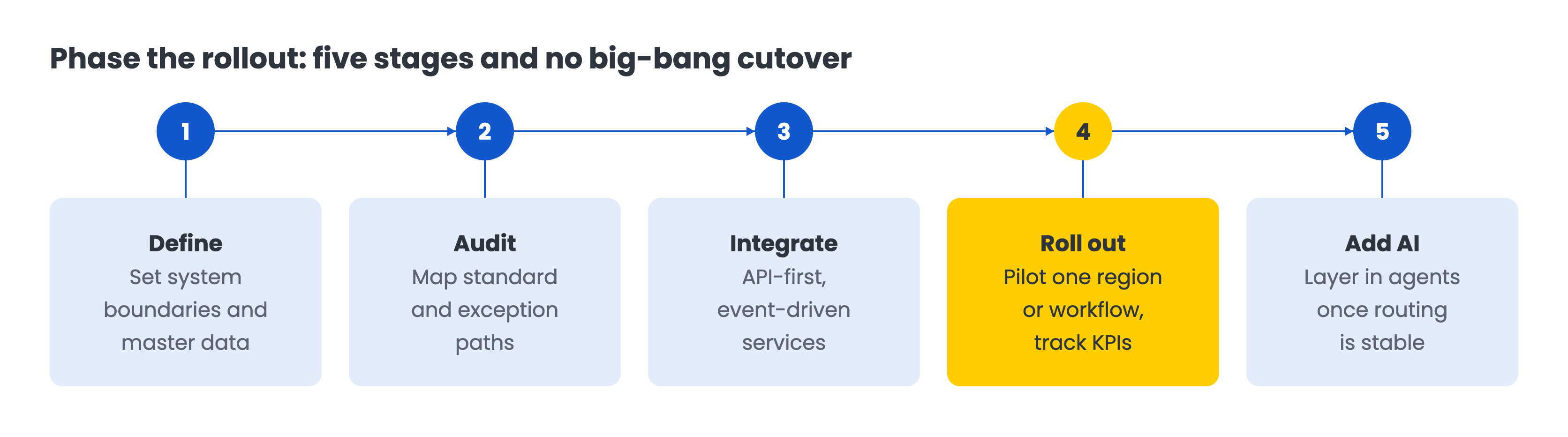
The rollout stage is the one that protects you: prove the model in one place before you scale it.
The common thread is one platform for every order. Commerce models are converging, and the businesses that win will run B2C, B2B, dropship and hybrid on a single foundation, with the rules to decide who gets served first when supply gets tight. That is where supply meets demand.
Go deeper. Read the 2026 Gartner® Magic Quadrant™ for Distributed Order Management for the full analyst findings and what they mean for your B2B and omnichannel roadmap.